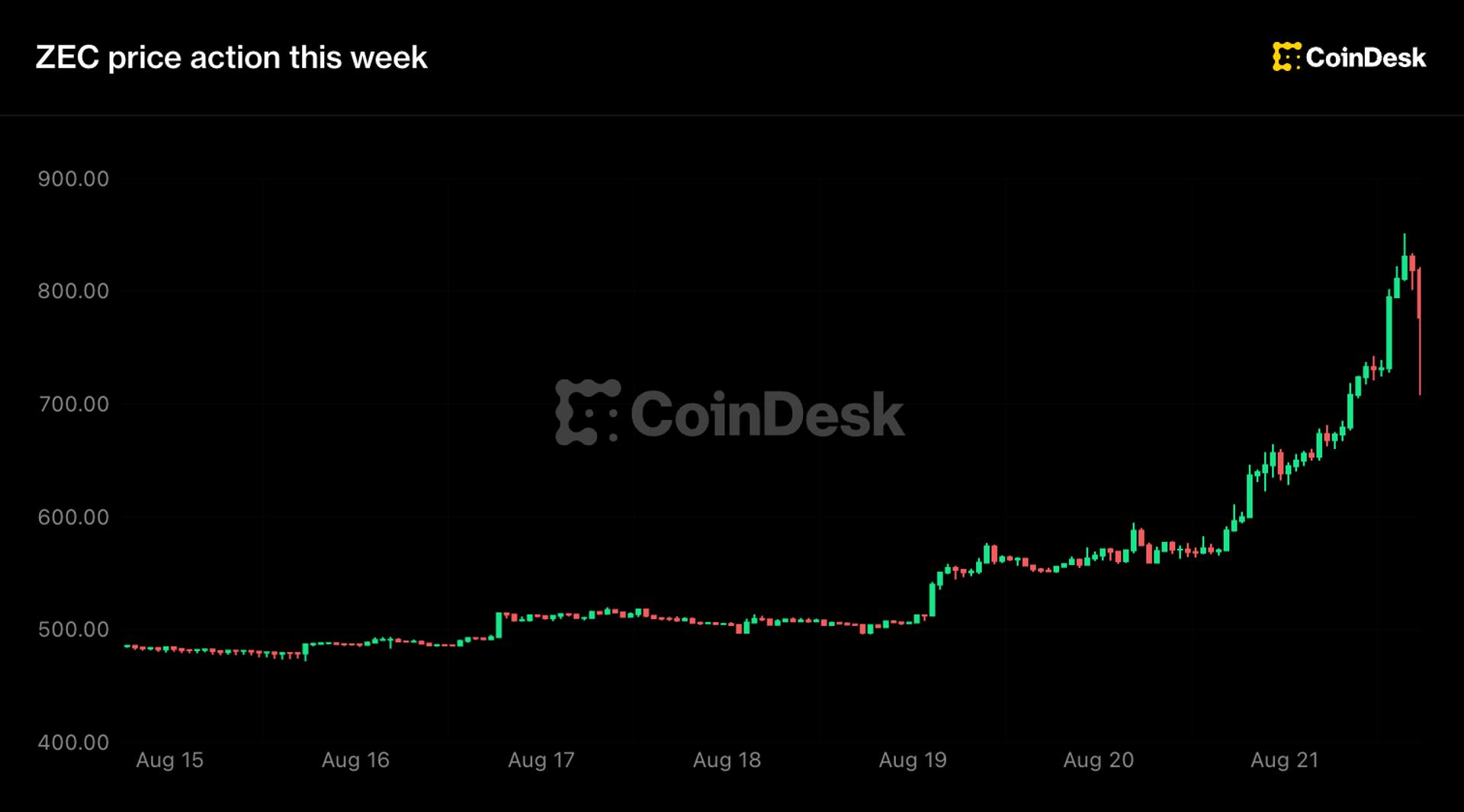
Zcash hit $800 per token, breaking above its January 2018 peak as institutional interest accelerated sharply. The move follows a Grayscale filing that advances the company's push to convert its Zcash Trust into a spot ETF, unlocking potential flows from traditional asset managers who cannot access crypto trusts.
The 48% surge in ZEC reflects two convergent pressures. First, Grayscale's regulatory momentum matters. The investment firm already operates the Grayscale Zcash Trust, which holds ZEC but trades at a discount to net asset value due to structural limitations. A spot ETF conversion would eliminate that friction, allowing shares to trade at true per-token value and attracting passive index trackers and institutional portfolios that default to SEC-approved vehicles.
Second, futures volume exploded into the billions of dollars. This signals genuine capital rotation, not retail speculation alone. When institutional traders move large notional amounts through derivatives markets, spot prices tend to follow. The volume surge indicates serious players are positioning for the next leg up, whether driven by ETF anticipation or broader momentum in privacy coins.
Zcash's privacy features separate it from Bitcoin and Ethereum. The protocol uses zero-knowledge proofs to shield sender, receiver, and transaction amounts from public view. This capability appeals to institutional treasurers managing sensitive holdings and jurisdictions with data confidentiality rules. It also courts regulatory scrutiny. Privacy coins face exchange delisting pressure in some regions and potential legislative crackdowns, but Zcash's opt-in shielded pools have helped it avoid the full ban hammer that other privacy assets face.
The comparison to Bitcoin in the narrative matters. Bitcoin spot ETFs became available in the United States in January 2024, opening a $70+ billion asset class to passive capital. Ethereum's spot ETF launch followed in July 2024. Both approvals coincided with sustained price rallies as inflows from fund managers and pension systems entered the market. Grayscale's Zcash filing taps into this exact playbook: regulatory approval plus institutional accessibility plus retail FOMO creates compounding price pressure.
The January 2018 peak carries historical weight. That bull run peaked right before the 2018 crash, which saw crypto markets shed over 80% in value. Breaking above that level psychologically signals new all-time highs could follow if the bull cycle holds. Traders interpret resistance breaks as validation that this rally differs from past cycles.
However, several risks temper the bullish case. Privacy coins remain regulatory wildcards. Tighter anti-money-laundering rules or exchange pressure could constrain liquidity if Zcash faces listing restrictions. The Grayscale filing faces no guaranteed approval timeline. SEC review of crypto products has accelerated under recent leadership, but privacy assets sit in a gray zone that makes timeline forecasts difficult.
Zcash also lacks Bitcoin's network dominance or Ethereum's smart contract ecosystem. Its use case depends on adoption by institutional treasurers and users prioritizing anonymity. Adoption remains niche relative to Bitcoin or Ethereum, which constrains its addressable market and limits how high valuations can run before demand saturation hits.
The current rally hinges on ETF approval momentum and institutional FOMO entering before spot vehicles launch. Traders betting on Grayscale's conversion success are front-running expected inflows. If the SEC delays or rejects the application, ZEC likely retreats sharply as speculative positioning unwinds.