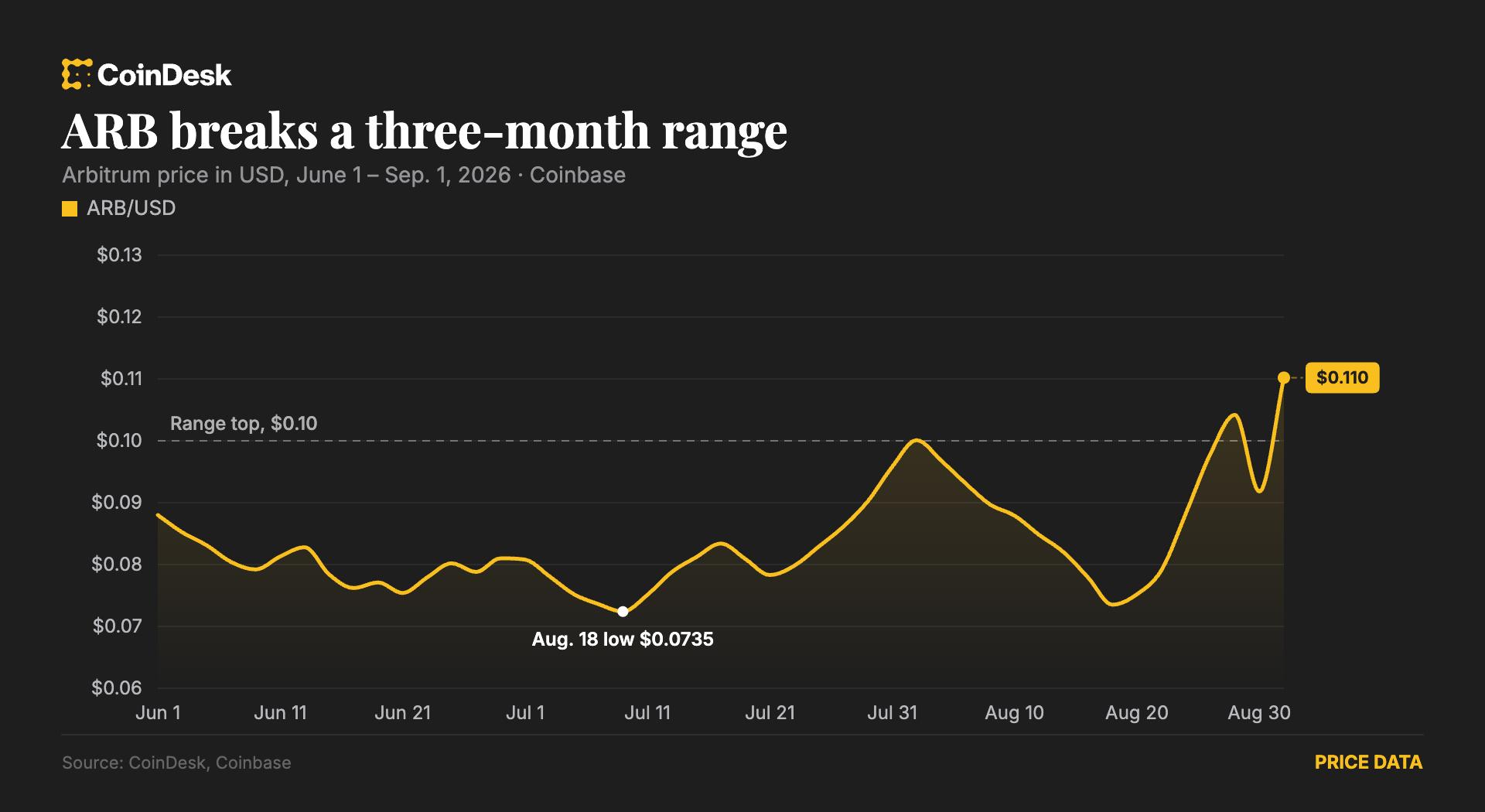
Robinhood Chain, the retail brokerage's Layer 2 blockchain built on Arbitrum, has crossed a threshold that marks real commercial traction. The network posted $1.9 million in daily protocol revenue, a new all-time high that immediately triggered a 30% price surge in ARB, Arbitrum's native token.
The revenue spike tells a specific story. Robinhood Chain doesn't generate revenue from token sales or speculative mechanics. Revenue flows from actual transaction activity. Users pay fees to settle trades, move assets, and interact with the network. When that number hits $1.9 million in a single day, it reflects genuine adoption, not hype cycles.
Robinhood, which launched its own Layer 2 chain in March 2024, built the network explicitly to lower trading costs and execution speed for retail investors. The strategy worked. By building on Arbitrum's proven infrastructure, Robinhood avoided reinventing settlement mechanics while maintaining its own sovereign economic model. Users pay fees in RHO, the chain's native token, but the architectural choice meant avoiding the massive engineering burden of launching a standalone rollup.
The revenue surge has immediate downstream effects. ARB holders benefit from Arbitrum's position as the underlying Layer 2 technology provider. Token holders saw the coin spike 30% on the back of Robinhood Chain's breakout day, reflecting market expectations that higher Layer 2 activity eventually translates to greater demand for the parent protocol's security and sequencer services.
This dynamic reveals how Layer 2s create token velocity beyond their own networks. When a major application like Robinhood drives adoption on Arbitrum infrastructure, it strengthens the entire ecosystem. Arbitrum processes the settlement, collects a portion of fees, and accumulates data that justifies token value. Other Arbitrum-native projects benefit from the increased network activity and user influx.
Robinhood's retail user base gives this move particular weight. The platform has roughly 24 million users in the U.S. alone. If even a fraction of that audience routes transactions through Robinhood Chain, the throughput dwarfs smaller Layer 2 competitors. The economics become self-reinforcing. Higher volume attracts more developers. More developers build products. More products drive usage.
The $1.9 million daily revenue figure needs context. Ethereum generates roughly $15-20 million per day in protocol revenue at typical activity levels, though it spikes higher. Solana, despite much lower fees, often exceeds $1 million daily. Robinhood Chain hitting $1.9 million in a single day suggests either a major trading event, liquidation cascade, or sustained high-volume activity across the network.
The ARB rally also signals trader confidence in the broader Arbitrum ecosystem. If Robinhood Chain can achieve this level of activity post-launch, the token market prices in expectations that other high-profile applications will follow similar paths. Each major app that deploys on Arbitrum strengthens the network effect and justifies higher token valuations.
Watch whether Robinhood Chain sustains this revenue level. One record day doesn't prove product-market fit. Consistent performance above $1 million daily revenue would signal that the network solved a real problem for retail traders and that Layer 2 adoption dynamics have fundamentally shifted away from speculation toward functional use.