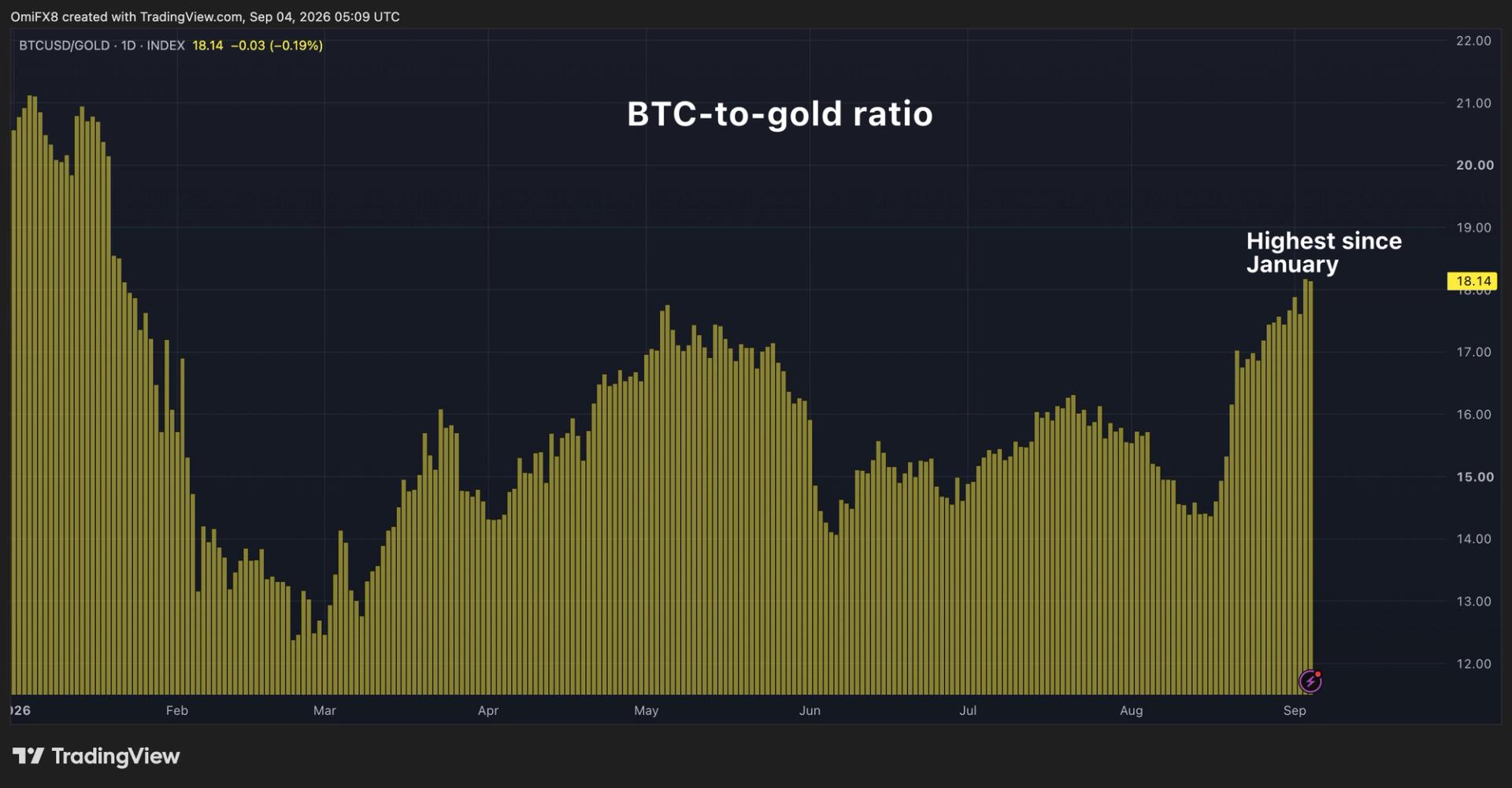
Bitcoin's price has climbed to a level where one BTC now purchases slightly more than 18 ounces of gold, marking the strongest bitcoin-to-gold ratio since January. The shift reflects renewed investor appetite for hard assets as traditional financial markets grapple with inflation concerns and debt sustainability questions.
The concurrent rally in both bitcoin and gold signals a shared narrative: investors are rotating capital into stores of value that cannot be printed into oblivion. This move contradicts typical market dynamics where rising bond yields tend to pressure both assets. Instead, the driver appears to be a deeper conviction that governments will pursue inflationary monetary policy to manage debt burdens rather than implement fiscal discipline.
Gold has historically served as the traditional hedge against currency debasement. Institutional investors and central banks hold gold as a confidence anchor. Bitcoin's outperformance of gold in recent months suggests that crypto markets are pricing in either more aggressive inflation expectations or faster adoption of bitcoin as a reserve asset. The 18-ounce-per-bitcoin milestone represents a psychological and technical threshold that hasn't been crossed since early January.
The timing matters. Bond yields have stabilized at elevated levels, yet both assets continue climbing. Normally, higher real yields would push investors toward fixed-income instruments and away from non-yielding assets. The persistence of bitcoin and gold strength despite this backdrop points to a specific market thesis: inflation expectations are overriding yield considerations. Investors are betting that nominal currency returns will erode faster than interest rates can compensate.
For bitcoin specifically, this dynamic validates one of crypto's original use cases. Satoshi Nakamoto designed bitcoin with a fixed supply of 21 million coins, explicitly to avoid monetary dilution. As macroeconomic conditions create windows where this property matters more, bitcoin's network effects and scarcity premium intensify. The ratio advantage over gold reflects both bitcoin's smaller market cap relative to gold's and institutional recognition of bitcoin's technical properties.
The 18-ounce level also tracks with broader bitcoin price momentum. When BTC appreciates faster than gold while both rally, it signals differential risk appetite. Traders willing to accept bitcoin's volatility are placing larger conviction bets on inflation outcomes. This contrasts sharply with the sideways price action seen when uncertainty peaks and investors rotate toward gold's lower volatility.
Looking forward, this ratio remains a useful barometer of risk sentiment within hard assets. If bond yields rise sharply and real rates turn positive, expect both bitcoin and gold to pull back, but gold typically outperforms bitcoin in such scenarios. Conversely, if central banks signal easier policy or inflation accelerates, bitcoin's superior supply rigidity should drive the ratio wider still. The January peak tested the market's inflation tolerance; whether this current move sustains above that level depends on whether debt concerns and monetary policy expectations remain the dominant narrative.
The current bitcoin-gold ratio also reflects changing institutional attitudes toward digital assets. Five years ago, this milestone would have seemed farfetched. Now it represents routine market mechanics where crypto serves alongside traditional hard assets in portfolio construction. This normalization of bitcoin as a macro hedge rather than pure speculation marks a structural shift in how capital allocates during periods of monetary uncertainty.