# Bitcoin's Return Concentration Problem: Why Market Timing Remains a Losing Game
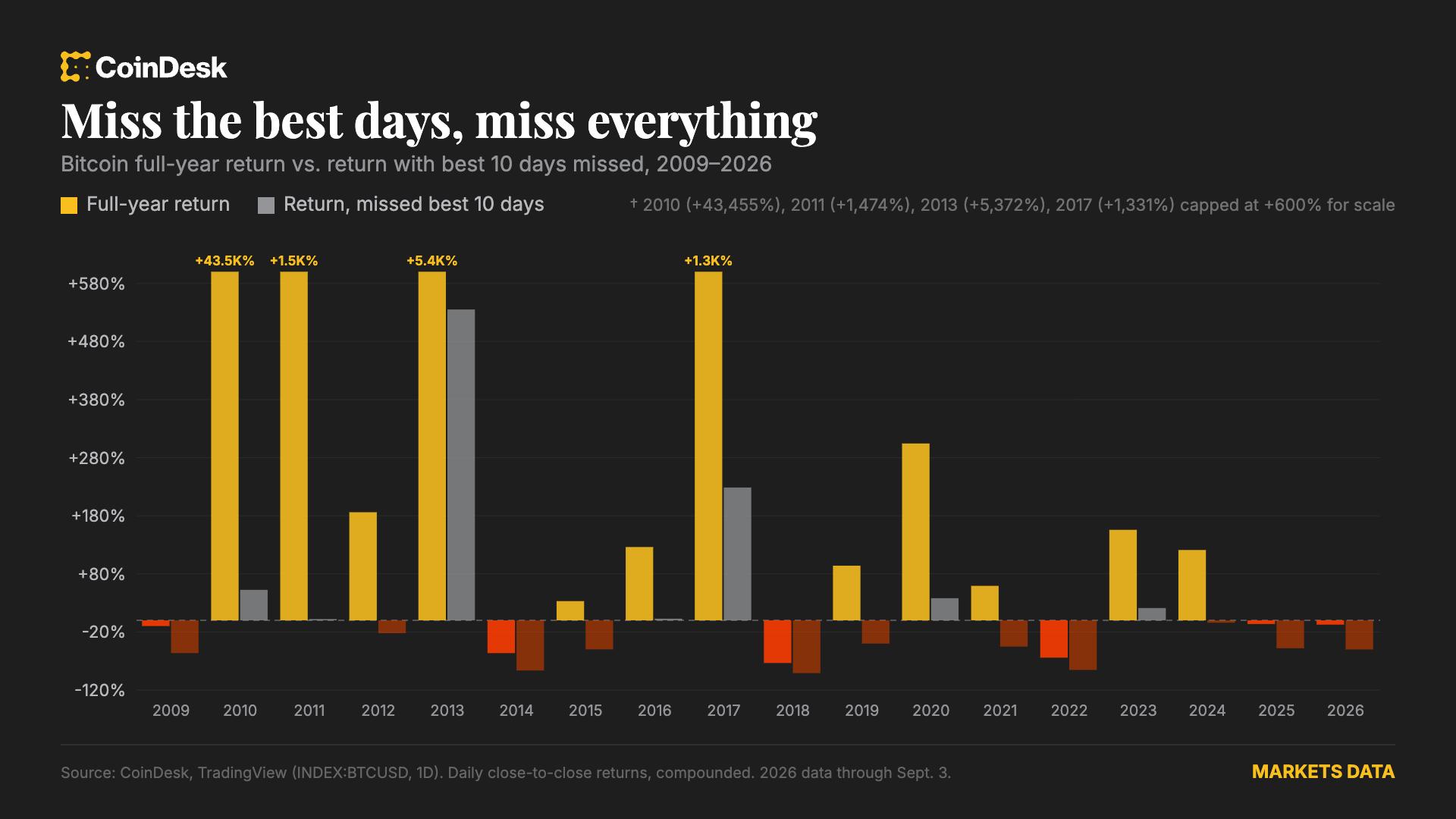
Bitcoin's returns cluster into explosive bursts lasting just days or weeks, leaving investors who try to time the market chasing mirages. A CoinDesk analysis spanning 2010 through 2026 reveals that the bulk of Bitcoin's annual gains occur during a minuscule portion of the year, making tactical trading decisions nearly impossible to execute profitably.
The research zeroes in on a harsh statistical reality. Bitcoin doesn't deliver returns evenly across the calendar. Instead, the asset front-loads its gains into specific windows, often just a handful of trading days. Investors who miss the ten best days in any given year see their returns crater. Miss twenty days and wealth generation effectively stops. This temporal clustering of returns punishes active traders and rewards patient holders.
The mathematics favor passivity. Since Bitcoin's inception, the asset has experienced multiple bull cycles and bear markets, yet the pattern holds consistent. The winners are the people who held through volatility. The losers are the ones who tried to sell at tops and buy at bottoms, inevitably missing the reversals that drive gains higher.
This finding contradicts the psychology that attracts retail traders to Bitcoin in the first place. Traders see Bitcoin's volatility and assume that volatility creates opportunity. They believe discipline and technical analysis can help them capture upside while avoiding downside. The historical data suggests otherwise. The perfect trade doesn't exist because identifying the best days requires knowing the future.
Consider the practical mechanics. A Bitcoin trader watching daily charts would need to make the right decision on a specific day, multiple times per year, just to break even with buy-and-hold investors after accounting for fees and slippage. The probability compounds against them with each trade. Exchanges charge fees. Market impact costs real money. Tax events trigger capital gains. These structural headwinds make outperformance mathematically grueling.
The analysis also applies to macro timing. Investors who waited for "better entry points" after Bitcoin's 2021 peak missed the subsequent rally from 2023 through 2024. Those who sold during the 2022 bear market to "protect capital" sold near lows. Every attempt to dance in and out of positions introduces a timing requirement that human psychology and available data cannot reliably satisfy.
This doesn't mean Bitcoin investors should ignore price action entirely. Risk management, position sizing, and portfolio allocation matter. But these are different from market timing. An investor can hold Bitcoin as a long-term portfolio position while still managing risk through position sizing and maintaining dry powder for genuine opportunities. The trap is assuming that active trading enhances returns when data shows it destroys them.
The 2010 through 2026 dataset carries additional weight because it includes multiple full market cycles. Bitcoin survived the 2014 Mt. Gox collapse, the 2018 winter, the COVID crash of 2020, and the 2022 decline following FTX's collapse. Through all of it, time-in-market beat timing-the-market. The pattern holds even when including some of Bitcoin's worst periods.
For retail investors, the takeaway simplifies to a core principle. Dollar-cost averaging into Bitcoin over years beats trying to predict daily swings. The best trade often is the one not taken.