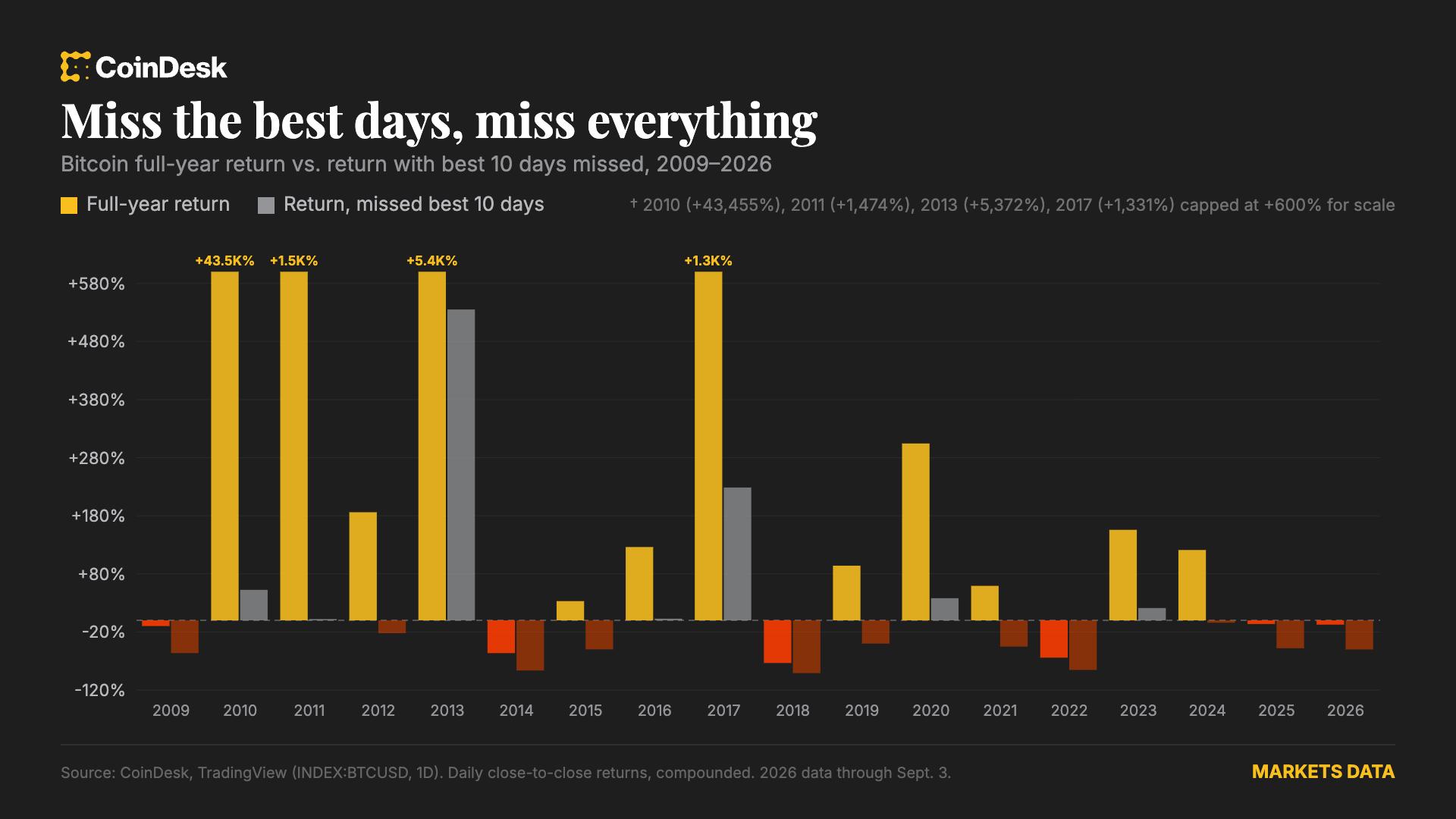
Bitcoin's path to long-term wealth creation runs through patience, not timing. Research examining bitcoin's price action from 2010 through 2026 reveals a brutal truth for market timers: the vast majority of annual returns compress into a handful of trading days scattered across each year.
This pattern repeats with mechanical regularity. Investors who hold bitcoin through full calendar years capture outsized gains. Those attempting to dodge volatility by sitting on the sidelines during "risky" periods consistently miss the exact windows when price surges occur. The data shows no reliable way to predict which specific days will drive the year's returns.
The mechanism behind this dynamic stems from bitcoin's volatility architecture. Price moves arrive suddenly, often triggered by macroeconomic shifts, regulatory announcements, or shifts in institutional capital flows. An investor sidelined in fiat during a three-day rally spanning a weekend can watch months of potential gains vanish. Conversely, traders overexposed during sharp selloffs face irreversible paper losses that erode conviction.
Historical modeling demonstrates the math punishes market timing with brutal efficiency. Missing just the top 10 trading days over a multi-decade period reduces cumulative returns by 50% or more. Missing the top 20 trading days crushes performance further. The probability that any individual investor correctly times entries and exits across multiple market cycles approaches zero. Even professional traders with real-time market data and sophisticated algorithms fail consistently at this game.
This analysis carries direct implications for retail investors navigating crypto volatility. Dollar-cost averaging into bitcoin positions removes the psychological burden of timing tops and bottoms. Regular purchases at predetermined intervals capture the asset at various price levels, averaging entry costs over time. The strategy acknowledges human inability to predict short-term price action while capitalizing on long-term appreciation odds.
The data also contextualizes recent bitcoin performance within its longer arc. Current price levels, while substantially above 2010s valuations, remain consistent with historical volatility patterns. Bear markets have arrived regularly throughout bitcoin's existence. Each correction prompted declarations that the asset was "finished." Each time, subsequent bull markets generated returns that rewarded long-term holders.
Risk management within a buy-and-hold framework differs from market timing. Holding duration horizons of five years or longer reduces the probability of capital loss to near-zero historically. Shorter holding periods introduce significant downside exposure. Investors comfortable maintaining positions through full market cycles, including drawdowns exceeding 60-70%, find their conviction rewarded when the price ultimately ratchets to new highs.
The broader lesson transcends bitcoin's specific technicals. Markets reward patience and punish overconfidence in prediction ability. The majority of wealth creation in any volatile asset class occurs during brief, unpredictable windows. Attempting to capture returns through precise timing consumes psychological energy while delivering inferior results. The historical record offers a clear verdict: buy bitcoin, hold it through cycles, ignore daily price action, and check back in years.