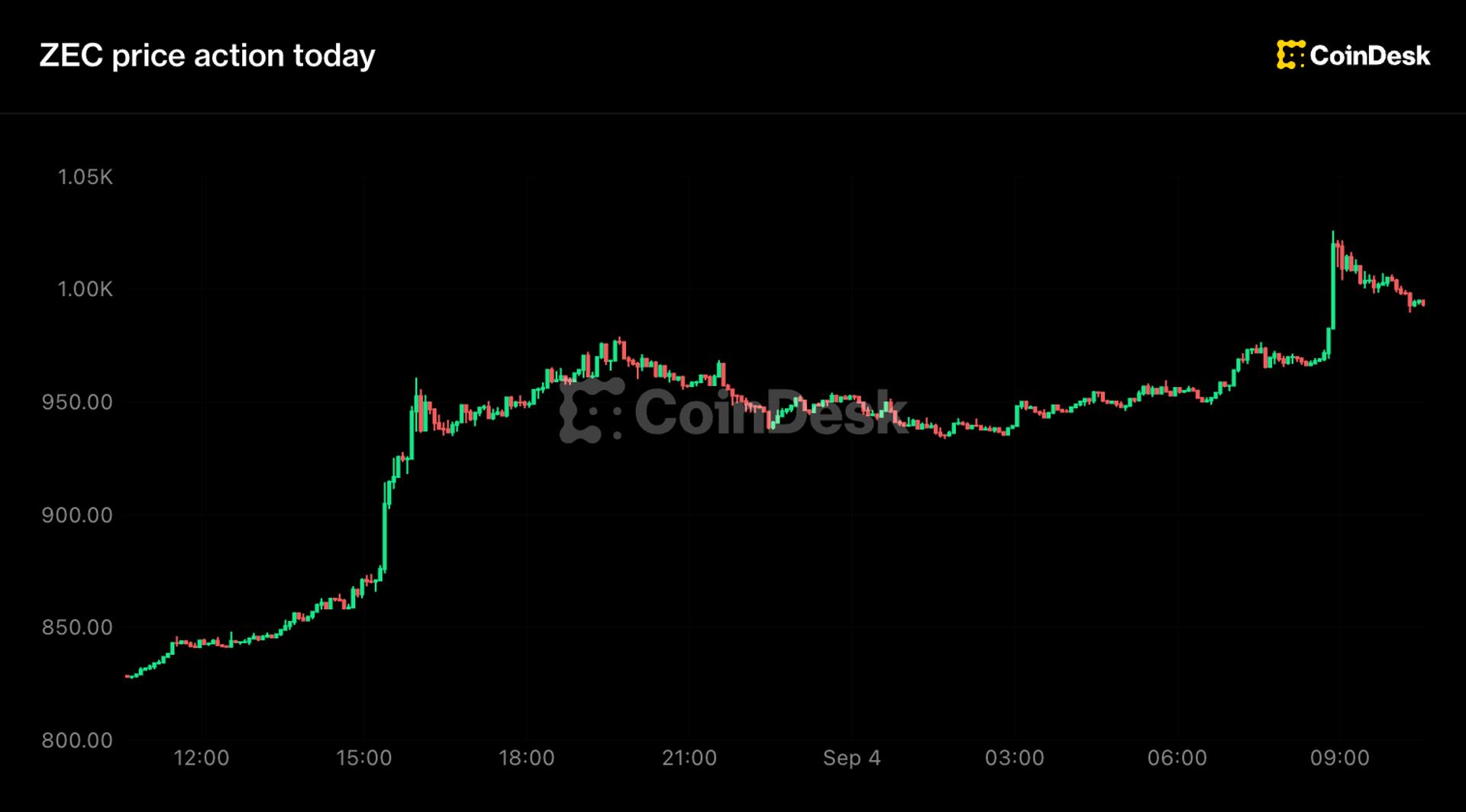
Zcash token surged past the psychological $1,000 barrier this week, marking a landmark rally that caught short sellers off guard. ZEC briefly climbed above $1,020 before settling, delivering a 20% gain that liquidated bearish positions worth $34 million across crypto derivatives platforms.
The spike represents the first time Zcash has sustained trading above four figures. Short liquidations accelerated the move higher, as traders holding leveraged bets against ZEC were forcibly exited from positions when collateral levels fell below exchange requirements. These cascading closures created additional upward pressure, compounding gains as automated liquidation bots sold short positions at market rates.
Zcash has traded under intense scrutiny since its 2016 launch. The protocol's privacy features, which allow shielded transactions that hide sender, recipient, and transaction amount, have attracted both legitimate privacy advocates and regulatory critics. The token spent years trading in the $50 to $200 range, making this week's $1,000 break a dramatic departure from historical performance.
Market conditions appear to have shifted in ZEC's favor. Bitcoin's recent strength and broader altcoin momentum have lifted privacy-focused assets off the floor. Monero, Zcash's primary competitor in the privacy coin category, has also climbed but trails ZEC's percentage gains. Ethereum's continued dominance in the smart contract space has shifted investor attention toward alternative layer-1 tokens and specialized-use protocols, creating space for niche assets to gain ground.
The short squeeze itself reflects broader market fragility. Heavily leveraged positions across crypto derivatives exchange margin books remain vulnerable to sudden price moves. When large liquidations trigger, they remove buying support at key price levels, forcing liquidators to execute sales into thinning order books. The $34 million in short liquidations suggests concentrated bearish bets that proved miscalibrated for current market momentum.
Regulatory headwinds continue hovering over privacy coins. The U.S. Treasury has expressed concerns about privacy tokens facilitating sanctions evasion and money laundering. Multiple exchanges delisted Zcash and Monero from their platforms in 2021 and 2022, citing regulatory compliance risks. Kraken and Huobi removed trading pairs despite offering OTC channels for institutional traders. This delisting risk caps upside potential and keeps volatility elevated.
Volume patterns matter here. A move to $1,000 on thinner-than-typical volume raises sustainability questions. If retail enthusiasm fails to materialize and short sellers rebuild positions at higher prices, downside vulnerability could emerge quickly. The privacy coin category remains structurally challenged by regulatory risk, limiting institutional adoption.
Zcash developers continue advancing protocol features through Halo 2, a zero-knowledge proof upgrade that improves efficiency and accessibility. These technical improvements address long-standing usability constraints, but they operate in the shadow of compliance uncertainty. The token's value ultimately depends on whether privacy functionality gains mainstream acceptance or faces legislative walls.
The $1,000 milestone carries symbolic weight. Zcash bulls now point to legitimate technical progress and market recovery. Skeptics counter that regulatory clamps tighten, not loosen. Short squeezes evaporate as quickly as they appear. The real test arrives when leveraged traders exit and price discovery resumes on fundamentals alone.