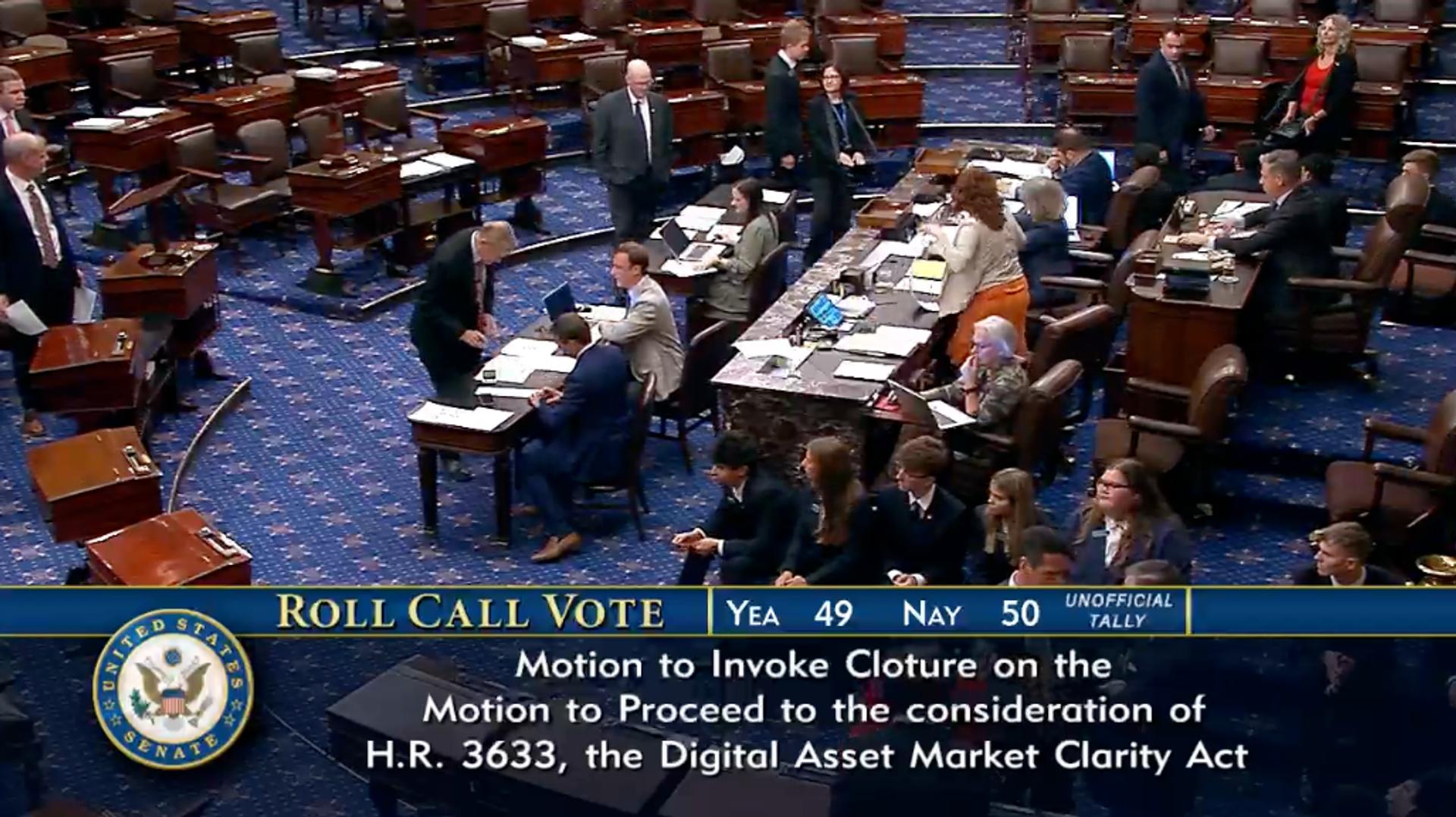
# Inside the Last-Minute Political Breakdown That Doomed the Clarity Act Vote
The Clarity Act, positioned as the crypto industry's best legislative shot at comprehensive regulatory clarity, collapsed under political pressure in its final hours. Behind-the-scenes disputes between key stakeholders fractured the coalition that had pushed the bill forward, leaving market structure reform—the industry's top policy priority—dead on arrival.
The bill faced opposition that materialized faster than supporters could manage. Industry players had treated the Clarity Act as a marquee achievement, a chance to establish clear SEC and CFTC jurisdictions over digital assets and prevent destructive regulatory overlap. But the alliance unraveled when competing interests within the crypto ecosystem—and skeptics in Congress—forced amendments and compromises that nobody could stomach.
Sources close to the negotiations point to disagreements over stablecoin treatment, derivatives oversight, and which regulator claims authority over which token categories. Environmental groups also pushed back on proof-of-work mining language, complicating the bill's path forward. Traditional financial institutions worried the legislation handed too much autonomy to crypto platforms without sufficient consumer protections.
The timing matters. This vote was scheduled as crypto lobby groups geared up post-election. The industry believed momentum existed after pro-crypto voices gained ground in 2024. Exchanges like Coinbase and trading platforms expected the Clarity Act to finally allow them to operate without constant threat of enforcement action from multiple agencies. Major crypto firms invested heavily in lobbying efforts, betting on a legislative win that would unlock institutional adoption and reduce legal risk.
Instead, proponents hit a wall. Last-minute horse-trading failed to bridge the gap between House and Senate versions. Neither side could agree on liability protections for exchanges, custody standards, or how to classify tokens that blur security and commodity lines. Some lawmakers backed away entirely, concerned the bill favored large exchanges over retail protection mechanisms.
The collapse signals a harder path forward for crypto regulation. Congress remains divided on whether to prioritize innovation incentives or consumer safeguards. Republicans generally favored lighter-touch oversight, while Democrats demanded stronger compliance frameworks. Moderate members of both parties couldn't craft language acceptable to all factions.
This failure carries real consequences for market structure. Without statutory clarity, the SEC continues classifying tokens as securities under outdated standards. The CFTC maintains parallel authority over derivatives. Platforms operate under the sword of Damocles, never certain which regulator's enforcement action comes next. The legal uncertainty bleeds into market cap and adoption rates.
Stablecoin issuers faced particular challenges within the bill's framework. Some Democrats wanted stablecoins designated as payment instruments requiring bank-like reserve requirements. Others preferred lighter categorization. That friction proved unresolvable.
The industry now faces a reset. Major crypto firms will likely pivot toward friendlier state regulators like Wyoming, which passed favorable digital asset laws years ago. They may also wait for 2026, betting that another electoral cycle shifts political math in their favor. Smaller players without lobbying budgets face the worst outlook, as regulatory uncertainty directly cuts into margins for non-custodial platforms.
The Clarity Act's collapse reveals the industry's legislative vulnerability. Crypto lacks the cohesion necessary to move unified federal policy. When stablecoin issuers, exchange operators, and mining firms each want competing outcomes, Congress sees an industry divided against itself. That fragmentation proved fatal to the bill and guarantees regulatory gridlock will persist for years.