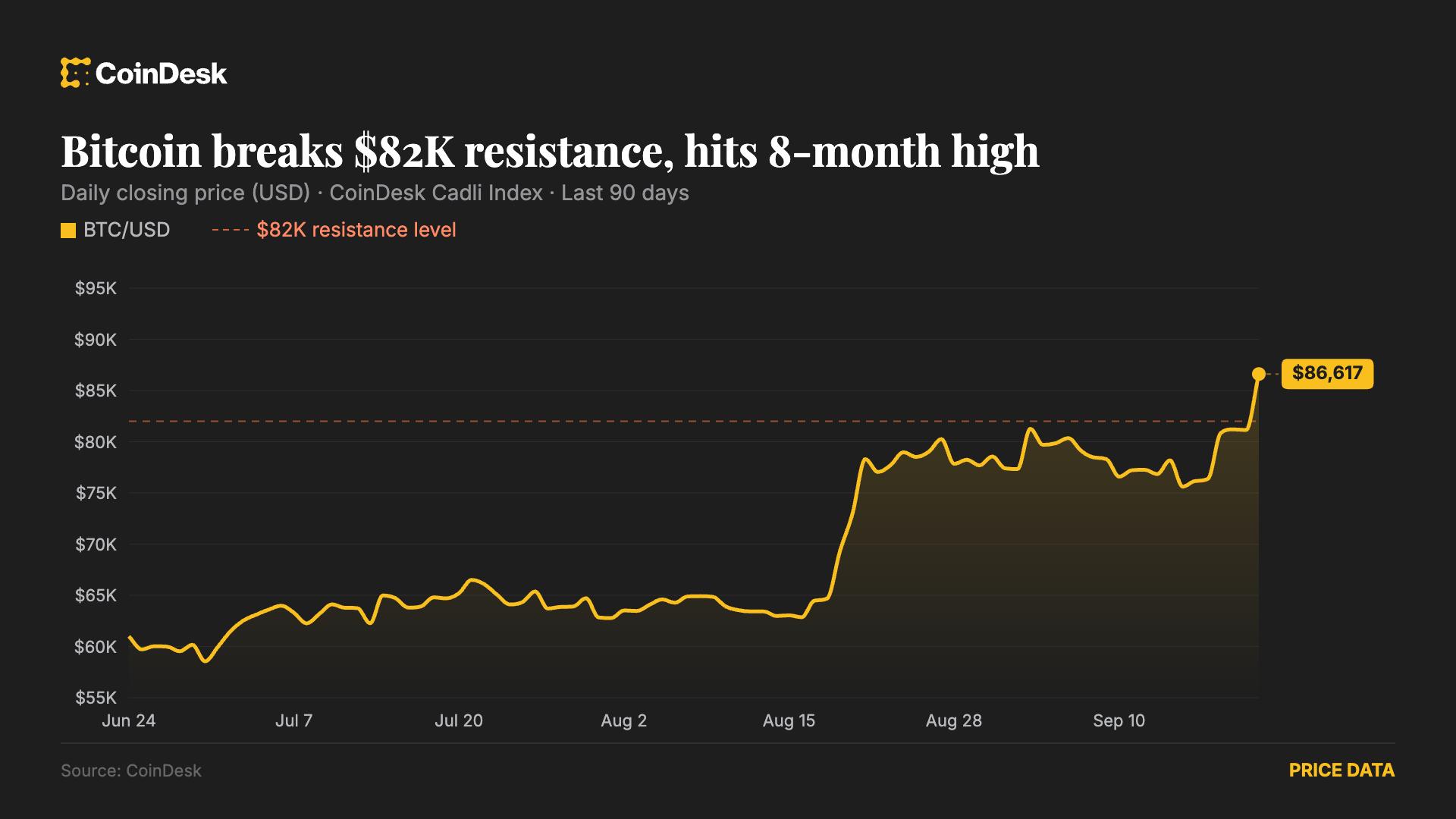
# Bitcoin Climbs to $86,000 as Leverage Builds Pressure on Short Traders
Bitcoin has surged to $86,000, breaking through resistance levels that signal momentum traders are capitulating. The move reflects a short squeeze dynamic where leveraged bears who bet against BTC are forced to buy back their positions at losses, creating a self-reinforcing upward spiral.
Analysts watching the move divide on what happens next. The path to $90,000 exists, but it depends entirely on whether the rally maintains fundamental buying pressure from spot market participants or simply runs on borrowed momentum from liquidations.
The short squeeze mechanism works like this. Traders holding leveraged short positions (bets that Bitcoin will fall) face mounting losses as the price climbs. Exchanges automatically liquidate undercollateralized shorts when price moves exceed their margin requirements. Those forced closures require buying Bitcoin to cover positions, which pushes price higher and triggers more liquidations in a cascade effect. This creates a self-sustaining rally disconnected from underlying demand.
Data shows leverage is accumulating across major exchanges. Futures funding rates remain elevated, indicating traders are willing to pay premium rates to hold leveraged longs. That behavior screams complacency. When funding rates spike, short-term pullbacks become violent because the leverage unwinds all at once.
The $86,000 level matters because it represents a clean breakout above previous resistance. Spot volume accompanying the move will determine whether this rally sticks. If institutional spot buyers (including ETF flows) continue absorbing supply, Bitcoin moves to $90,000 with structural support. If the move relied primarily on liquidation cascades and leverage unwinding, the pullback could be sharp once shorts finish covering.
Several traders flagged a critical risk. Every dollar higher creates more leverage-fueled buying, which attracts more risk-on positioning into an increasingly thin market. The setup resembles bubble dynamics where price movements disconnect from economic fundamentals and reflect only positioning and leverage rather than adoption or utility expansion.
Historical patterns suggest caution at these levels. Bitcoin rallies driven purely by leverage unwind tend to exhaust quickly. The $85,000 to $90,000 range has attracted heavy option selling, meaning significant resistance sits at round numbers. Traders are taking profits into these levels, which dampens continued acceleration.
What changes the narrative is sustained spot demand. Major spot ETF inflows would confirm the move as driven by real capital entering the ecosystem rather than traders liquidating shorts. Conversely, slowing inflows combined with rising leverage would signal the move is mechanical and vulnerable.
The next 48 hours matter. If Bitcoin tests $90,000 and fails, liquidation of longs will create downside pressure that mirrors the upside squeeze. The market built leverage in both directions, creating a pressure cooker where the first directional failure triggers a stampede toward exits.
Traders are treating this as a timing game rather than a conviction play. The mechanics favor further upside if spot demand persists, but positioning risk suggests the move will prove choppy and eventually mean-revert toward $80,000 or lower unless underlying on-chain metrics confirm genuine accumulation.