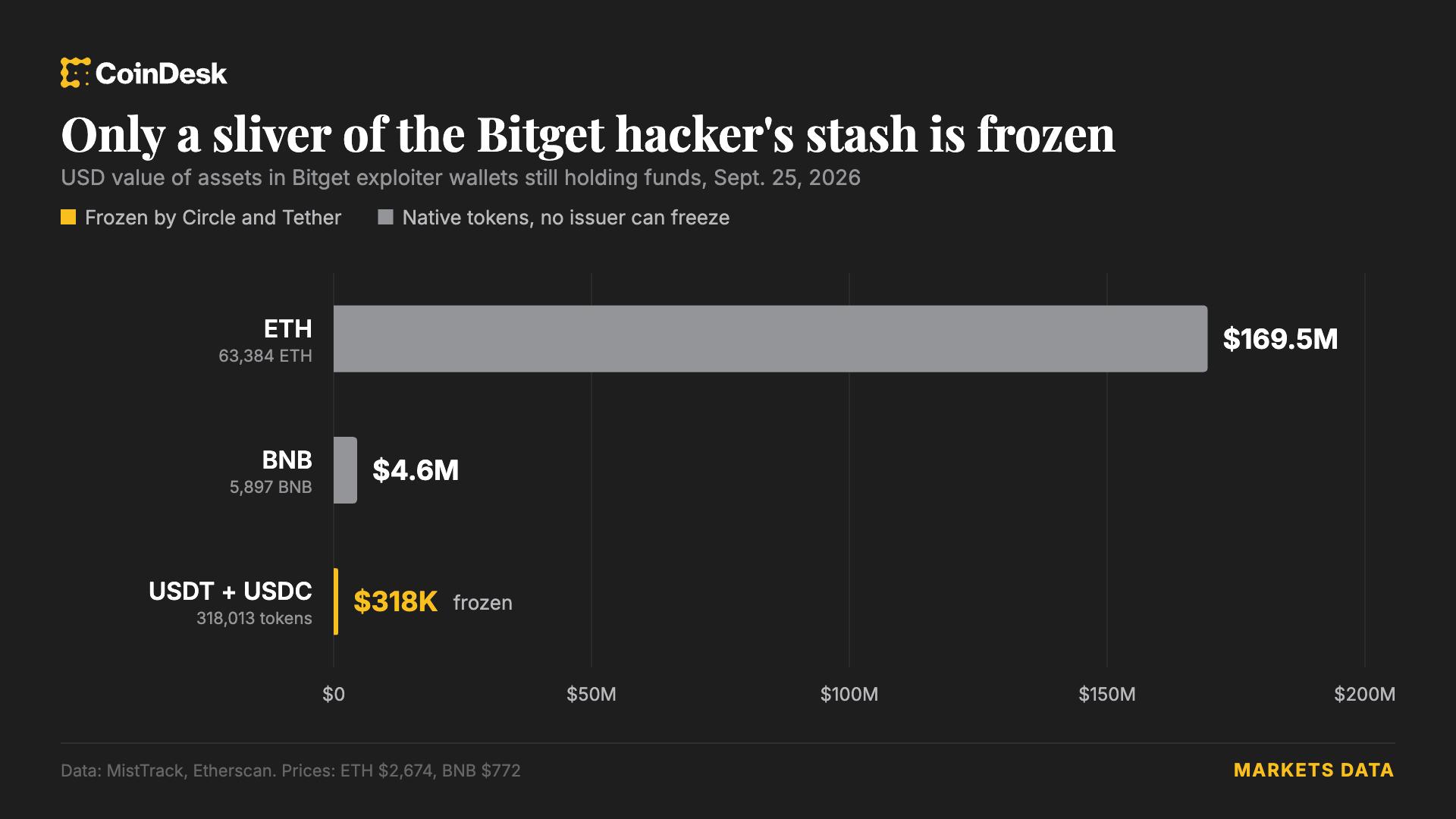
Circle and Tether moved swiftly to contain fallout from the Bitget hack by blacklisting a wallet holding roughly $318,000 in stablecoins. The rapid response demonstrates how issuer-level freezes function as a secondary defense layer after exchange security fails, though the tactic reveals its own limitations.
The Bitget breach, one of the crypto industry's largest exchange heists, resulted in attackers making off with millions in user assets. Hackers moved stolen funds across multiple addresses and tokens. Circle, which issues USDC, and Tether, the operator behind USDT, both added the identified wallet to their blacklist within hours of the breach becoming public. This prevents the addresses from moving or spending the stablecoins held there.
The $318,000 frozen represents a fraction of total losses. The bulk of stolen assets sit in ether, the native token of the Ethereum blockchain, which neither Circle nor Tether can freeze unilaterally. Ethereum runs without a central point of control. Token transfers execute through smart contract code, not issuer approval. Ether exists at the protocol layer, beyond the reach of any single entity's blacklist.
This exposes the real weakness in stablecoin-issuer defenses. When hackers diversify holdings across multiple assets, only a portion faces freezing risk. The attacker can hold ether, wrapped tokens, or other cryptocurrencies outside the stablecoin ecosystem entirely. The stolen ether from Bitget now sits in wallets the blockchain can track but not stop.
Law enforcement typically enters at this point. The FBI and international agencies monitor address activity and coordinate with exchanges to prevent cashing out. But on-chain monitoring lags real-time speed. Hackers gain hours or days to bridge funds across blockchains, use mixers, or trade into assets tied to fewer controls.
Bitget's security breach itself pointed to either compromised hot wallets or insider access. The exchange had previously raised $300 million at a $5.3 billion valuation, positioning itself as a major player in derivatives trading. The hack tarnished that reputation overnight and forced payouts from the exchange's insurance reserves.
Circle's blacklist action shows how stablecoin issuers now operate as quasi-regulators. They freeze accounts at the request of law enforcement and execute these orders independently. This power extends beyond traditional banking, since stablecoins represent bearer instruments on blockchain. A blacklist is terminal.
But reliance on blacklists creates a false sense of security. Users who held assets in the Bitget hot wallet faced total loss regardless of stablecoin freezes. The exchange's controls failed first. The frozen stablecoins belonged to the hacker after successful theft, so blacklisting those funds provided little direct victim relief.
Going forward, the incident reinforces why institutional exchanges maintain separate cold storage. Bitget's architecture apparently kept too much in hot wallets or used insufficient multi-signature controls. The hack also accelerates discussion around MPC technology and distributed custody solutions that remove single points of failure.
Tether and Circle's response was textbook damage control, but it addressed only the visible, easily freezable portion of losses. The real damage sat in ether and other Layer 1 assets immune to blacklisting.