# STRC Dividend Strategy Targets $100 Recovery as Token Struggles Below Psychological Level
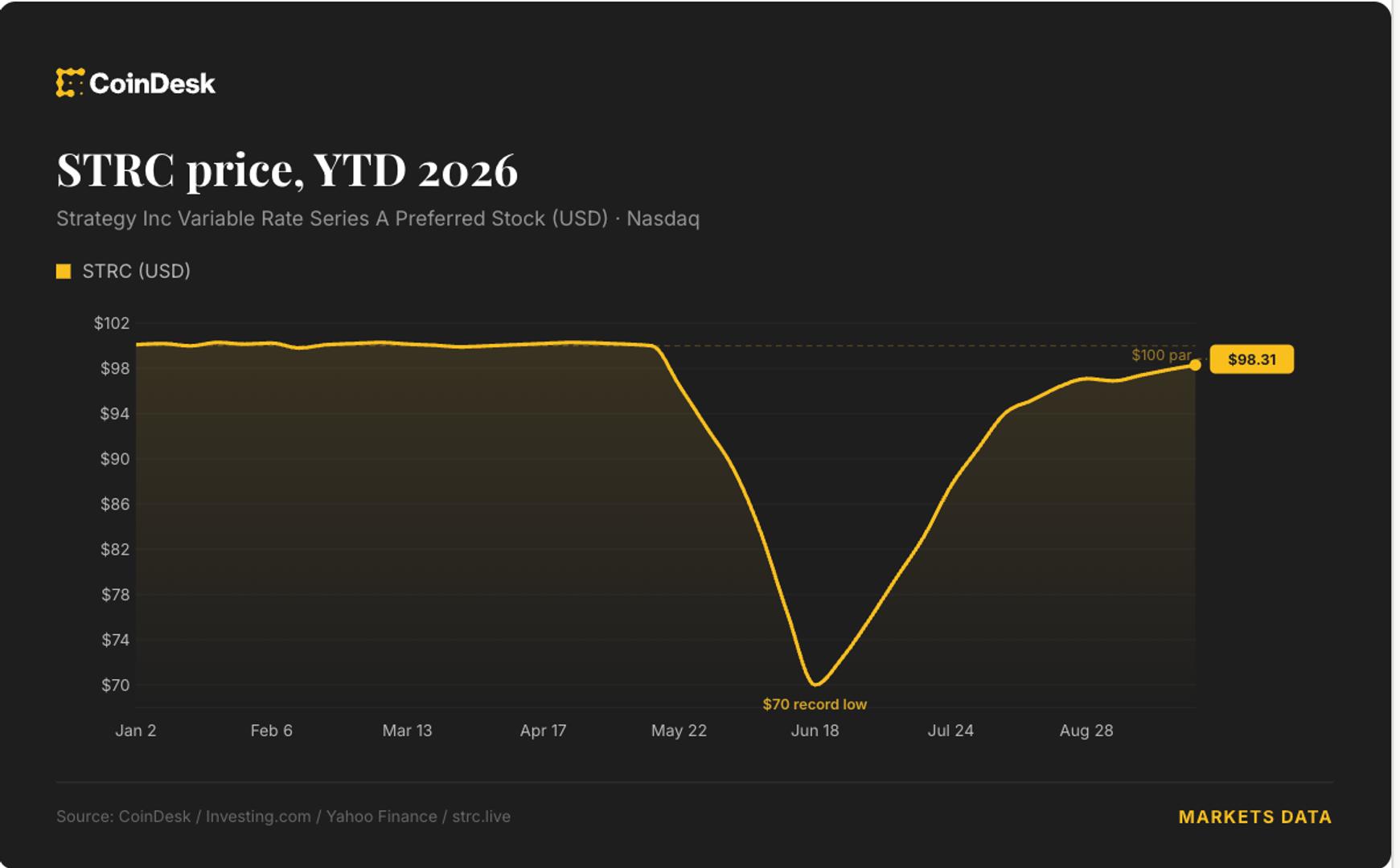
STRC trades well below its $100 target despite aggressive shareholder incentives, signaling deeper market pressures than dividends alone can address.
The token has languished below $100 since May, even as management maintains a 12% dividend rate and executes approximately $1 billion in preferred share buybacks. The persistent underperformance prompted a new proposal to shift toward daily dividend distributions rather than the current payment structure.
The rationale centers on behavioral economics and portfolio mechanics. Daily payouts theoretically create consistent buy pressure as investors receive rewards and maintain positions. This differs sharply from periodic distributions, which can trigger selling waves once investors receive lump sums. The psychological anchor of $100 also matters. Tokens trading below round-number levels often face downside momentum, as stop losses cluster and traders position for further declines.
The buyback program itself reveals institutional confidence in fundamentals. Retiring roughly $1 billion in preferred shares reduces share count and theoretically increases per-token value for remaining holders. Yet the market has discounted this accretion, suggesting either skepticism about token utility or broader macro headwinds affecting the entire sector.
Daily dividend mechanics introduce complexity. Blockchain infrastructure must support frequent on-chain payments without bloating transaction costs. Gas fees or protocol overhead could consume significant portions of smaller daily distributions, especially if redemptions occur through multiple wallets. The proposal likely contemplates batched settlements or off-chain aggregation before final distribution, but implementation details remain critical.
This strategy echoes earlier dividend-focused plays in crypto, particularly in staking-derived tokens and yield-bearing protocols. Ethereum staking rewards and Lido's LDO token demonstrated that consistent yield can attract capital, but only when underlying protocol value supports token demand. Dividends alone rarely reverse downtrends without improvements to network fundamentals or adoption metrics.
STRC's valuation pressure may reflect concerns about adoption, competition, or macroeconomic factors independent of distribution timing. A shift to daily dividends costs little to implement but risks becoming a subsidy masking structural problems. If the token's utility or demand remains weak, even daily payouts merely delay the reckoning.
The $100 threshold carries symbolic weight in retail markets. Breaking through that level would signal momentum reversal and potentially trigger technical buying. Alternatively, if daily dividends prove insufficient, management may face pressure to increase the dividend rate itself, which would accelerate capital burn and raise sustainability questions.
Implementation timing matters. Crypto volatility tends to peak during risk-off periods, when even high yield cannot offset broader deleveraging. A daily dividend launch during a market rally could show early success, while launching into weakness would test dividend resilience immediately.
The proposal represents a tactical adjustment rather than a fundamental fix. If STRC's underlying protocol generates strong cash flows supporting dividends, daily distributions could optimize capital return efficiency. If cash flows depend primarily on token issuance or unsustainable yield generation, the strategy merely accelerates the clock on viability questions. Market reaction to the proposal itself will signal whether traders view this as a genuine governance improvement or financial engineering.