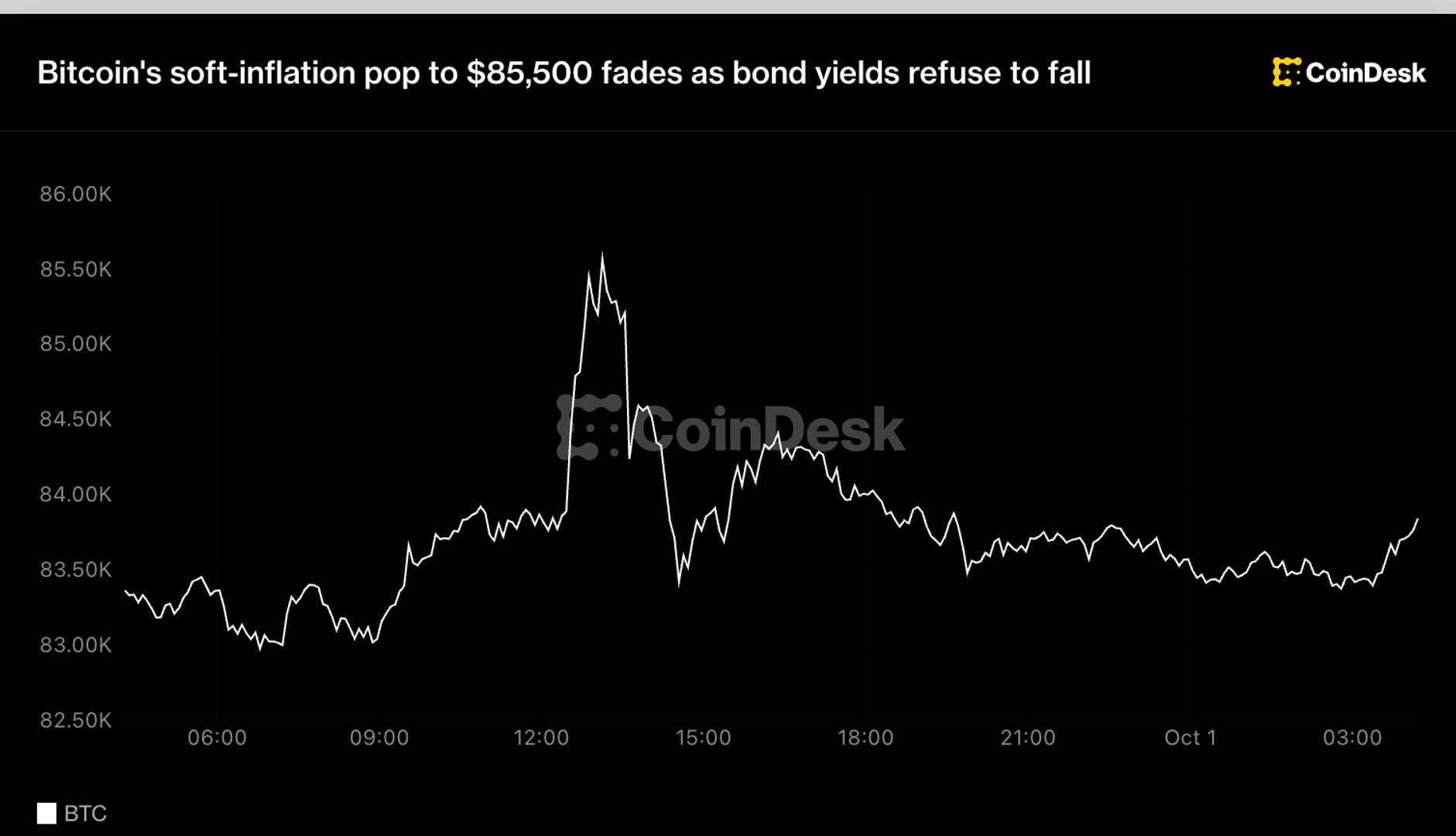
Bitcoin rallied to $85,500 on Wednesday following a softer-than-expected Personal Consumption Expenditures inflation report, but the move proved temporary as Treasury yields refused to fall and the cryptocurrency retreated from those heights.
The PCE reading, which tracks price changes in consumer spending, came in cooler than consensus estimates. This typically signals lower inflation pressures and potential relief for risk assets like bitcoin, which struggle when real yields spike. For roughly four hours, that narrative held. Bitcoin punched through $85,000 for the first time in days, drawing momentum from traders betting that inflation fears might finally ease and the Federal Reserve could dial back its hawkish stance.
The rally collapsed just as quickly. U.S. Treasury yields stayed pinned near their highest levels since 2002, with the 10-year hovering well above 4.5 percent. This stuck point reveals a hard truth about the current market: inflation cooling alone does not guarantee yield compression or risk asset recovery. Long-duration bonds remain under pressure from structural headwinds like fiscal deficits, geopolitical tensions, and a Fed that shows no appetite to cut rates aggressively. Even soft inflation numbers cannot compete with those forces.
Bitcoin lives in the inverse relationship between real yields and risk appetite. When Treasuries pay more and the Fed stays restrictive, bitcoin carries an opportunity cost. Holding the non-yielding asset makes less sense when government bonds offer 4.5 percent with zero credit risk. The cryptocurrency needs either a rate-cut signal or a major de-risking event to reignite conviction. A single PCE beat does neither.
The failed breakout above $85,500 underscores a pattern we have seen repeatedly this cycle. Bitcoin rallies on dovish headlines, meets selling from traders taking profits and institutions hedging, then reverses when macro data fails to shift the broader yield trajectory. Traders pricing in significant rate cuts by mid-2025 have been repeatedly disappointed. The Fed telegraphed its terminal rate strategy months ago. Inflation surprises, even positive ones, do not override the central bank's core concern: avoiding a policy error that reignites price growth.
Treasury market structure matters more than bitcoin bulls want to admit. The 10-year yield sits where it does because real demand for long-term U.S. debt has weakened relative to supply. Foreign central banks buying fewer Treasuries, domestic savers rotating into alternatives, and the need to finance a massive fiscal deficit all keep yields elevated. A PCE print cannot fix those mechanics overnight.
Bitcoin will need to decouple from rate expectations to find a new floor. That could happen through a genuine recession that forces the Fed's hand, a geopolitical shock that drives flight-to-crypto rather than flight-to-safety, or a shift in the institutional narrative around digital assets that prices them on utility rather than macro arbitrage. None of those catalysts arrived on Wednesday.
The brief $85,500 surge serves as a reminder that bitcoin remains hostage to yield dynamics. Until Treasury yields sustainably compress, rallies built on single data points remain vulnerable to quick reversals.