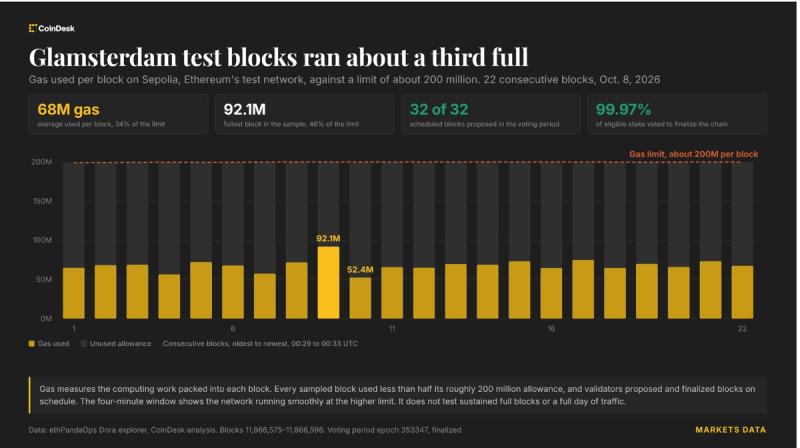
Ethereum's Sepolia testnet has demonstrated increased transaction processing capacity following a recent upgrade. The test runs on Glamsterdam achieved a gas limit approaching 200 million per block, representing more than a threefold increase from previous levels.
Despite the expanded capacity, actual usage patterns showed restraint. Sampled blocks consumed less than half of the available gas allowance, according to CoinDesk reporting. This gap between theoretical capacity and real-world demand reflects current network conditions on the test environment.
The upgrade represents ongoing efforts to scale Ethereum's base layer. Glamsterdam testing provides a controlled setting to evaluate how the network behaves under expanded gas parameters before any potential mainnet implementation. The results demonstrate both the technical feasibility of higher processing budgets and the current demand dynamics on test networks.
Sepolia serves as Ethereum's primary public testnet, allowing developers and researchers to simulate network behavior before changes reach the main blockchain. The threefold increase in processing budget marks a notable step in Ethereum's scaling roadmap, though the disconnect between available and used capacity suggests network demand may not yet require such elevated limits on test infrastructure.
The testing phase allows the Ethereum community to observe how validators, clients, and applications respond to significantly higher transaction throughput. These rehearsals inform decisions about production network upgrades and help identify potential technical constraints or optimization opportunities before mainnet deployment.