# Solana, Ether, XRP Lead Market Decline as Geopolitical Risk Triggers Broad Crypto Selloff
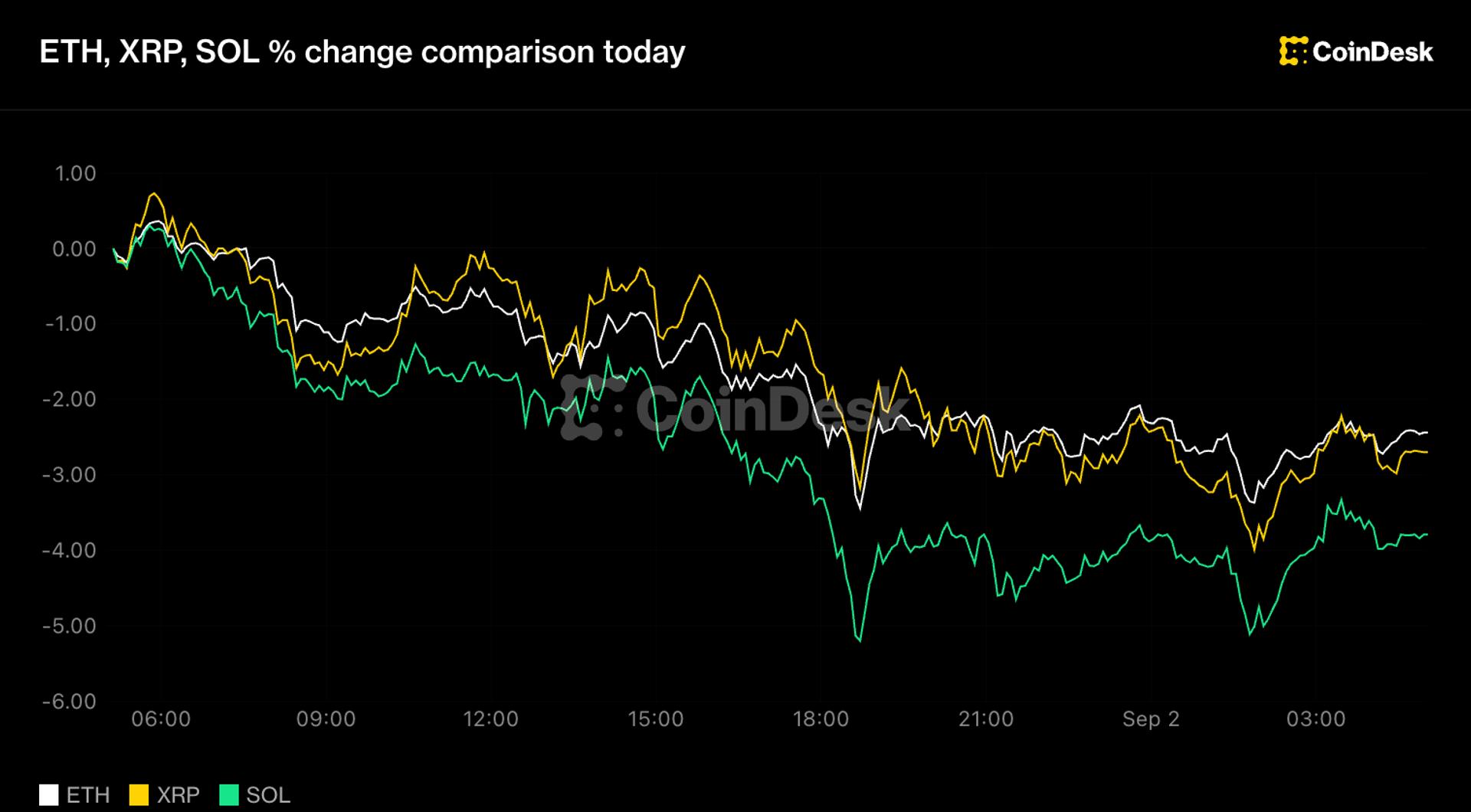
Cryptocurrency markets sold off sharply over the past 24 hours as geopolitical tensions spiked following Iran's military strikes. Bitcoin led the retreat with the most stability, while higher-beta altcoins suffered disproportionate losses.
Solana, Ethereum, and XRP dropped roughly three times harder than Bitcoin, a pattern consistent with how risk assets behave during broader market stress. When volatility spikes, investors flee lower-cap and more speculative tokens first, rotating capital toward perceived safe havens. Bitcoin's relative resilience reflects its status as the most liquid and established cryptocurrency, though even BTC did not escape losses.
The selloff extended across the entire large-cap universe. Every token in the top tier by market capitalization recorded declines, signaling a synchronized flight to safety rather than selective weakness in specific chains or protocols. This behavior mirrors traditional markets, where geopolitical shocks trigger indiscriminate deleveraging.
Iran's military action created a cascade of risk reassessments across financial markets. Crypto proved particularly sensitive because the space attracts leverage-heavy trading positions. When margin calls cascade through exchanges and derivatives platforms, forced liquidations amplify downward pressure. Altcoins with thinner order books and lower trading volume experience worse price discovery, explaining why Solana, Ethereum, and XRP absorbed sharper blows than Bitcoin.
The timing matters for market structure. High-beta majors like Solana have built substantial positioning among retail and institutional traders betting on ecosystem adoption and protocol development. When risk sentiment inverts, these thesis-driven trades unwind first. Bitcoin, by contrast, trades partly as a macro hedge and store of value. Holders with longer time horizons weather short-term volatility differently than traders chasing Ethereum's DeFi narrative or Solana's throughput advantage.
Market depth reveals the mechanics. Bitcoin's trading infrastructure spans dozens of exchanges with billions in daily volume. Solana and XRP rely on fewer liquidity pools relative to their market caps. A $100 million sell order impacts Bitcoin differently than Solana. The widening losses across altcoins reflected this structural disadvantage.
Ethereum's decline matters beyond price action. The chain processes trillions in total transaction value annually through DeFi protocols, staking, and NFT activity. Sharp Ether weakness can trigger liquidations within lending protocols like Aave and Compound, creating feedback loops that deepen losses. The 3x decline versus Bitcoin suggested some liquidation pressure rippled through the ecosystem.
XRP's performance raised different concerns. Ripple's token derives value partly from adoption narratives around On-Demand Liquidity for cross-border payments. Geopolitical risk that constrains global financial flows directly threatens the use case. If governments tighten capital controls or banks de-risk emerging market exposure, demand for ODL rails may weaken, justifying XRP's outsized loss.
The selloff underscores a reality for altcoins. Narrative-driven tokens depend on macro sentiment and risk appetite. When fear spikes, investors abandon growth stories and reach for liquidity. Bitcoin's inelastic supply and network effects provide some insulation. Altcoins lack equivalent anchors, leaving them vulnerable to momentum-based selling.
Recovery trajectories will depend on geopolitical de-escalation and whether volatility attracts new capital flows. Stablecoin volumes surged during the decline, typical of investors raising dry powder or protecting gains. If tension eases without escalation, risk appetite may return faster to altcoins than to broader markets, given crypto's faster price discovery mechanisms.